
What Is a vCISO? Role, Duties and When You Need One

A vCISO, or virtual Chief Information Security Officer, is an experienced security specialist who leads your information security from outside the company. They usually work a set number of days or hours a month instead of being an employee. They give you the strategic judgement of a CISO without a full-time executive salary. If you are a Polish company facing ISO 27001, GDPR, NIS2 or a demanding customer questionnaire and nobody on your team owns security at management level, a vCISO is the role designed to fill that gap.
This guide explains what the role covers, what it does not, how it differs from a full-time CISO, which deliverables to expect, and how an information security management system (ISMS) fits in, with examples of its documents.
What does vCISO mean?
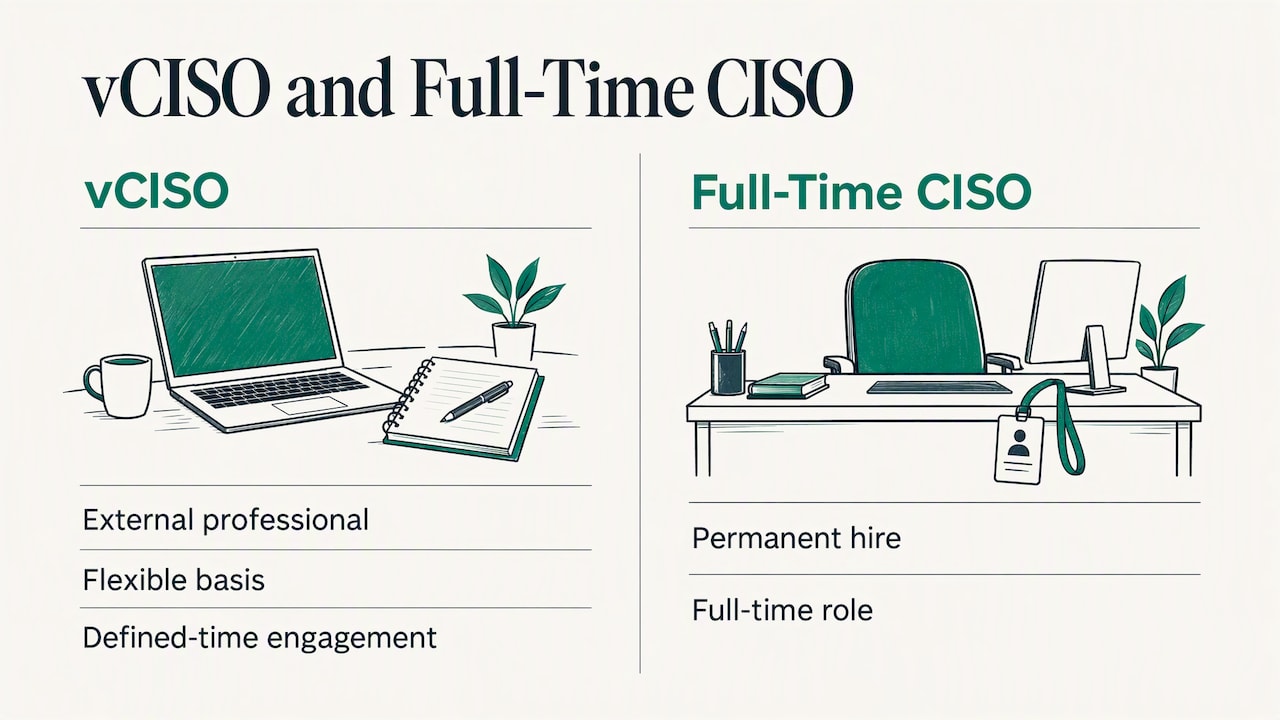
CISO stands for Chief Information Security Officer: a senior executive responsible for developing and implementing an organisation’s information security programme. The “v” stands for virtual. In practice that means the person is not on your payroll. They are an external professional who delivers the same kind of leadership on a flexible basis.
You will also see the same idea under other names: virtual chief information security officer, fractional CISO, or CISO as a service. They all describe a security leader you engage for a defined amount of time rather than hire permanently. The vCISO can be a single practitioner or a provider that stands behind the role with a team.
TechTarget notes that a vCISO is external and may work part-time, as a consultant, or in a hybrid online and in-person way, which gives more flexibility than a full-time CISO.
What does a vCISO do?
The role is about leadership, not about operating tools. A vCISO decides, with your management, what needs protecting, what could go wrong, how much risk you accept and what you will do about the rest. Typical responsibilities fall into five groups.
Strategy and roadmap
The vCISO turns the vague worry “are we secure?” into a plan. That means a security strategy tied to the business, a prioritised roadmap and a budget that management can approve. Without this, security in a mid-sized company tends to become a series of reactions to the latest problem.
Risk management
They run or review the risk assessment: which assets matter, which threats and weaknesses apply, who owns each risk and what happens to it (reduce, transfer, avoid or accept). Suppliers belong here too, because a weak provider is your weak point.
Policies and governance
They define the rules: an information security policy, access control, backup, incident handling, supplier requirements, training. They also make sure responsibilities are named, so that the rules are followed rather than filed.
Compliance oversight
For a Polish organisation this often means keeping ISO 27001, GDPR and, where it applies, the national cybersecurity act (KSC) and NIS2 requirements in one coherent programme instead of four separate projects. We cover the legal anchors below.
Reporting to management
One of the most valued skills is communication. ISACA’s journal points out that a vCISO needs to explain security in business terms to executives and the board, and in technical language to IT. A vCISO who cannot do both is not worth their hours.
What a vCISO does not do
Knowing the limits prevents disappointment. A vCISO works a defined number of hours and in an advisory capacity. In most engagements they do not configure your firewalls, administer your servers or sit on call handling daily alerts. Those tasks stay with your IT staff or a managed service provider. If you need hands-on testing, that is a separate piece of work, such as a penetration test or vulnerability scan.
Decisions also stay with you. A vCISO recommends, coordinates and prepares, but the management board owns the risk and signs off the plan. This is the right design: security is a management responsibility, and an outsider cannot accept risk on your behalf.
vCISO vs full-time CISO
TechTarget describes the difference this way: a vCISO provides strategic security leadership, governance and risk oversight on a flexible, part-time or project basis, whereas a full-time CISO is an in-house executive embedded in daily operations. The vCISO scales well for smaller or growing organisations, and a full-time CISO suits large, complex environments.
| Criterion | vCISO | Full-time CISO |
|---|---|---|
| Employment | External, contract or subscription | Employee |
| Time commitment | Agreed hours or days per month | Full-time |
| Best for | Small and mid-sized or growing organisations | Large, complex organisations |
| Focus | Strategy, governance, risk, compliance | All of this plus daily internal leadership |
| Flexibility | Can scale up or down, or run a single project | Fixed headcount |
| Institutional knowledge | Built over the engagement | Deep, internal |
The roles overlap more than they differ. They carry similar responsibilities and differ mainly in how they are delivered. The practical question is not which is better, but how much senior security work you actually have each month.
When does a company need a vCISO?
You probably have a case for one if several of these are true:
- Someone must own information security, but the work does not fill a full-time senior role.
- A customer, tender or partner asks for security evidence, a questionnaire or an ISO 27001 certificate.
- You want to implement ISO 27001 and nobody in the company has done it before.
- You fall under the national cybersecurity act or NIS2 rules and need someone to translate them into a plan. Obligations depend on the specific entity, so check your own status first; our NIS2 overview explains who is covered.
- You have had an incident or an inspection and need senior help quickly.
- Your IT manager is carrying security as a side job, and it shows.
Engagements come in two shapes. vCISOs may be hired for a short-term fix to a security issue, or for a longer project such as developing a whole security programme. A short engagement might be a gap analysis before an audit. A long one is a monthly retainer that keeps the programme alive.
How a vCISO helps with ISO 27001, GDPR and audits in Poland
Polish organisations rarely face one framework at a time. A vCISO is useful precisely because they look across all of them.
GDPR
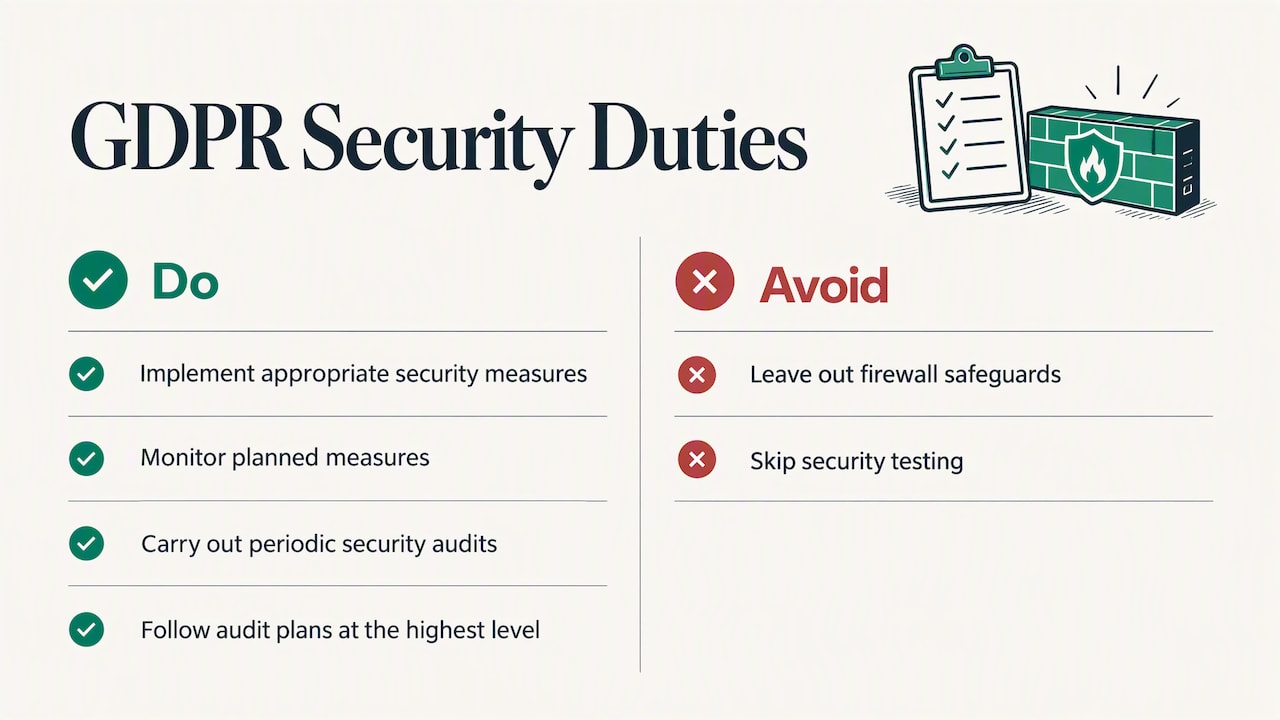
The GDPR requires controllers and processors to implement appropriate technical and organisational measures, adapted to the processing context, the state of the art and the risks to individuals. The EDPB also advises monitoring the planned measures and carrying out periodic security audits, with the action plan of each audit followed at the highest level of the organisation. That is a governance task, and it is where a vCISO’s reporting line to management matters.
The Polish regulator shows what failure looks like. In a 2026 case, UODO found that Fortum and Pika had not implemented appropriate technical and organisational measures, including firewall safeguards and security testing. The same page refers to ISO/IEC 27001 and ISO/IEC 27002 as relevant standards for security management when processing personal data.
ISO 27001
ISO 27001 is the standard for an ISMS. If you are weighing it up, our page on ISO 27001 and who it covers is a good start, and the free ISO 27001 readiness test shows where you stand.
One point saves many companies money. According to the Polish Ministry of Digital Affairs, the law does not require certification just because an organisation must maintain an ISMS that meets the standard. Applying the standard without certifying can satisfy the requirement, subject to the applicable legal context. A vCISO helps you decide whether certification is worth it for your commercial situation or whether alignment is enough.
Audit preparation
The audit itself is the auditor’s work, but readiness is a management task: scoping, assigning owners, running internal reviews and closing findings. Remember where the responsibility sits. An ISO/IEC working group note states that the organisation has final authority and responsibility for implementing its ISMS, and that auditors look for evidence of conformity. A vCISO can coach the team, but they cannot produce your evidence for you.
What is an ISMS? Examples of documents and evidence
An ISMS, called SZBI in Polish, is a management-system model for protecting an organisation’s information assets from threats. A vCISO usually builds it, reviews it or keeps it running. The Polish Office of Technical Inspection (UDT) describes ISO 27001 implementation as involving these elements:
- an ISMS policy,
- identification and assessment of risk,
- evaluation of risk-treatment options,
- selected controls,
- a Statement of Applicability,
- a risk-treatment plan,
- implementation of the selected safeguards.
To make that concrete, here is how those elements look in a small company’s ISMS.
| Element | What it looks like in practice |
|---|---|
| ISMS policy | A short document signed by management that states security objectives and scope |
| Risk register | A table of risks with asset, threat, likelihood, impact, owner and chosen treatment |
| Statement of Applicability | A list of controls, marking which apply, why, and whether they are implemented |
| Risk-treatment plan | Actions, owners, budget and deadlines for risks you decided to reduce |
| Procedures | Access management, backup, change management, supplier checks, incident response |
| Records | Review minutes, internal audit reports, training logs, incident records, test results |
The last row is the one companies forget. Policies say how work should be done. Records prove it was done. Auditors ask for both, so an ISMS that exists only as a folder of policies will not hold up. Evidence has to be generated continuously: reviews held, tests run, incidents logged, corrective actions closed.
If you operate in a regulated sector, the legal framework adds requirements. Poland’s consolidated KSC Act requires covered operators to maintain a security-management system that includes systematic risk assessment, proportionate technical and organisational measures, documented continuity plans, continuous monitoring, information about threats and vulnerabilities, incident management and preventive measures. In other words, the same building blocks, written into law.
What to expect from a vCISO engagement
A vague engagement produces vague results. Before you sign, agree these points in writing:
- Scope. Which frameworks, which business units, which systems.
- Authority and reporting line. Who the vCISO reports to, usually a board member or the managing director, and what they may decide.
- Availability. Hours or days per month, response times, who covers absences.
- Deliverables. For example a security roadmap, a risk register, policies, supplier assessments, a management report.
- Cadence. A regular meeting with management and a periodic written report with decisions taken.
- Handover. What documents and knowledge stay with you if the engagement ends.
A sensible first cycle produces a validated list of assets, the material risks with named owners, an escalation path, a funded action plan and a record of which residual risks management has knowingly accepted. That is a tangible output a board can read.
When choosing a provider, look for experience in strategy, risk and communication with executive boards, and ask how the work is documented. A provider that works inside a system, rather than in scattered files, makes your records easier to audit and easier to hand over.
How Guardiso supports the vCISO role
Guardiso is an ISO 27001 certified company. We offer a vCISO service alongside our compliance platform, so that the person guiding your security programme and the system holding your documentation work together.
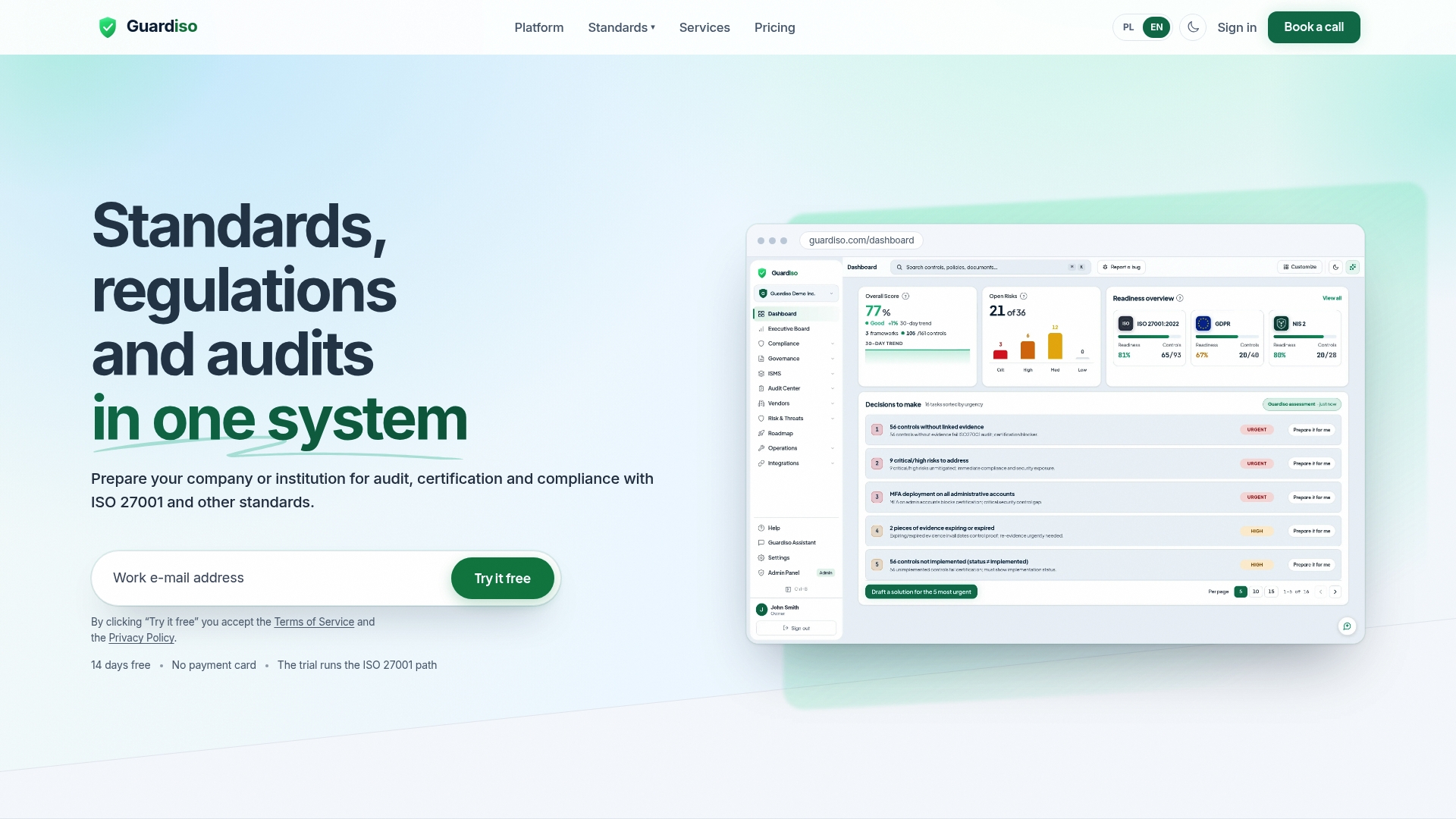
The platform links requirements across ISO 27001, GDPR, NIS2, DORA, SOC 2 and other standards, so a policy or control written once can be reused for several frameworks. It includes document and policy templates in Polish and English, risk and evidence registers, audit planning and an auditor portal. Plans start at 849 zł per month (Starter) and 2149 zł per month (Professional) on our pricing page, and Enterprise is arranged individually. vCISO engagements have no published price, so talk to us about the scope you need. If you want the full picture first, start from the Guardiso homepage.
How to decide: three quick questions
- Is there a senior person accountable for security today? If the answer is “the IT manager, in spare time”, the gap is real.
- Is there an external deadline? A certification, a customer audit, a regulator’s inspection or a legal obligation makes a vCISO’s structure valuable quickly.
- Can you keep the evidence going without help? If you can assign owners and keep records yourself, a smaller engagement, such as a review every quarter, may be enough.
If you answered “no”, “yes”, “not sure”, a time-boxed engagement aimed at one outcome, such as audit readiness, is the usual starting point.
FAQ
What does CISO stand for?
CISO stands for Chief Information Security Officer. It is the senior executive responsible for developing and implementing an organisation’s information security programme. A vCISO does the same job as an external, flexible resource.
Is a vCISO the same as a consultant?
Not quite. A consultant usually solves one defined problem and leaves. A vCISO takes on a continuing leadership role, with a reporting line to management, regular meetings and ownership of the security programme. Some engagements start as a project and grow into a retainer.
How many hours a month does a vCISO work?
It depends on the agreement. The role is typically a few days a month, and the hours are set in the contract. Preparation for an audit or an incident may call for more in a given period, so agree how extra time is requested and recorded.
Does a vCISO replace our IT team?
No. The vCISO sets direction, manages risk and reports to management, while your IT team or provider carries out the technical work. The two roles complement each other.
Do we need ISO 27001 certification to work with a vCISO?
No. A vCISO can help you decide whether to certify or simply apply the standard. Under the Ministry of Digital Affairs’ position, applying it without certification can meet an ISMS requirement, depending on the legal context.
Sources
- What is a CISO (chief information security officer)? | TechTarget
- What is a virtual CISO (vCISO)? | TechTarget
- What is a CISO as a service (CISOaaS)? | TechTarget
- Virtual CISOs: Security Leader or Security Risk? | ISACA Journal
- Secure personal data | EDPB
- News and events | UODO
- Infrastruktura krytyczna | Ministerstwo Cyfryzacji
- ISO/IEC 27001 | UDT
- Ustawa o krajowym systemie cyberbezpieczeństwa (tekst jednolity)
- Auditing Practices Note on the Statement of Applicability | ISO/IEC JTC 1/SC 27