
GRC vs ERM: How the Two Approaches Differ and Fit Together

ERM (enterprise risk management) is the discipline of identifying, assessing and steering risks that could affect the organisation’s strategy. GRC (governance, risk and compliance) is the wider umbrella that joins governance, risk and compliance activities into one coordinated capability. ERM is therefore one deep part of what GRC covers, and most organisations of any size end up needing both. The rest of this guide explains where they differ, where they overlap and how an EU company can run them together without doing the same work twice.
What GRC and ERM mean
The acronym GRC was created by OCEG in 2002. OCEG describes it as an integrated collection of capabilities that helps an organisation reliably achieve objectives, address uncertainty and act with integrity. Three words matter in that definition: integrated, capabilities and objectives. GRC is not a single team or a single tool. It is the way governance (who decides and who is accountable), risk (what could go wrong) and compliance (what the organisation must or has promised to do) are made to work together.
ERM is narrower and more specific. It is a structured approach to identifying risks across all business functions, assessing them, deciding how much of each the organisation will accept and reporting on them to leadership. Its anchor is strategy: which uncertainties could stop the organisation reaching its goals, and are they within appetite?
A useful way to remember it:
- GRC asks: are we governed well, do we understand our risks and are we meeting our obligations?
- ERM asks: which risks matter most to our strategy, how big are they and what are we doing about them?
Because ERM covers one of the three letters in GRC, the question “GRC or ERM?” is often really a question about scope. Do you need a risk programme, or a programme that also ties in policies, controls, audits and regulatory obligations?
GRC vs ERM at a glance
| Aspect | ERM | GRC |
|---|---|---|
| Core question | Which risks threaten our objectives, and are they within appetite? | Are we governed, risk aware and compliant, with evidence? |
| Scope | Risk across all business functions | Governance, risk management and compliance together |
| Typical driver | Strategy, board appetite, resilience | Regulation, standards, customer assurance, internal control |
| Main outputs | Risk register, appetite statement, risk reports to the board | Policies, control library, audit and evidence records, obligation tracking |
| Typical owners | Risk function, usually a second line role | Shared across compliance, security, legal, risk, IT and internal audit |
| Meaning of the term | A discipline and a function | A framework, and also a common name for software |
The term “GRC” is used in two ways. The Hackett Group describes GRC as a control centre that turns the risk information from ERM into actionable plans, with ERM making sure the organisation is prepared for potential risks and GRC making sure operations stay aligned with objectives and the law. The IIA Norway guidelines for the risk function (2025) point out that the market also uses “GRC” for systems that register risk assessments, control data and test results across functions. Both meanings are legitimate, so it helps to say which one you mean in a meeting.
Where they differ in practice
Scope and horizon
ERM looks outward and forward. It asks about market shifts, supplier concentration, cyber exposure, regulatory change and operational failure, and weighs each against strategic goals. GRC looks across the whole control environment. It keeps policies current, maps controls to requirements, schedules audits and keeps evidence that the controls work.
Who does the work
The ERM function usually sits in the second line, alongside functions such as compliance, IT security, legal and quality control. The IIA Norway guidelines describe it in just those terms. GRC activity, by contrast, runs through the whole organisation. The IT team collects configuration evidence, HR confirms training, legal tracks regulatory change, internal audit tests the result and the board reads the summary.
Tempo and output
ERM tends to run on a planning and review cycle: risk identification workshops, quarterly risk reports and an annual appetite review. GRC activity is more continuous. Controls are tested, tasks are assigned, evidence is refreshed and findings are tracked to closure. An ERM report answers “what are our top risks?” A GRC report answers “what is our compliance status and what is open?”
The strategic versus compliance tension
The two streams can pull in different directions, and that is a good reason to keep both visible. Risk Publishing gives an example: a data localisation obligation may be met by a control that still leaves an unacceptable concentration of vendor risk. The compliance view marks the obligation as satisfied. ERM still raises the residual strategic risk to the board. Both views are correct, and the board needs both.
Where they overlap
The overlap is considerable. Both disciplines care about risks, rely on an inventory of controls, report to the board and depend on the three lines model for independence, as Risk Publishing sets out. In mature organisations the enterprise risk register feeds the risk module in the GRC platform, and the control library in the GRC platform feeds the residual risk scoring in the ERM register.
The IIA Norway guidelines say internal control, risk management and compliance may be described under one umbrella as GRC, and that they are separate areas which should not and cannot be managed in isolation. That is the practical message of the whole comparison. You can organise the work in different teams, but the information has to connect.
How to run both without duplicating effort
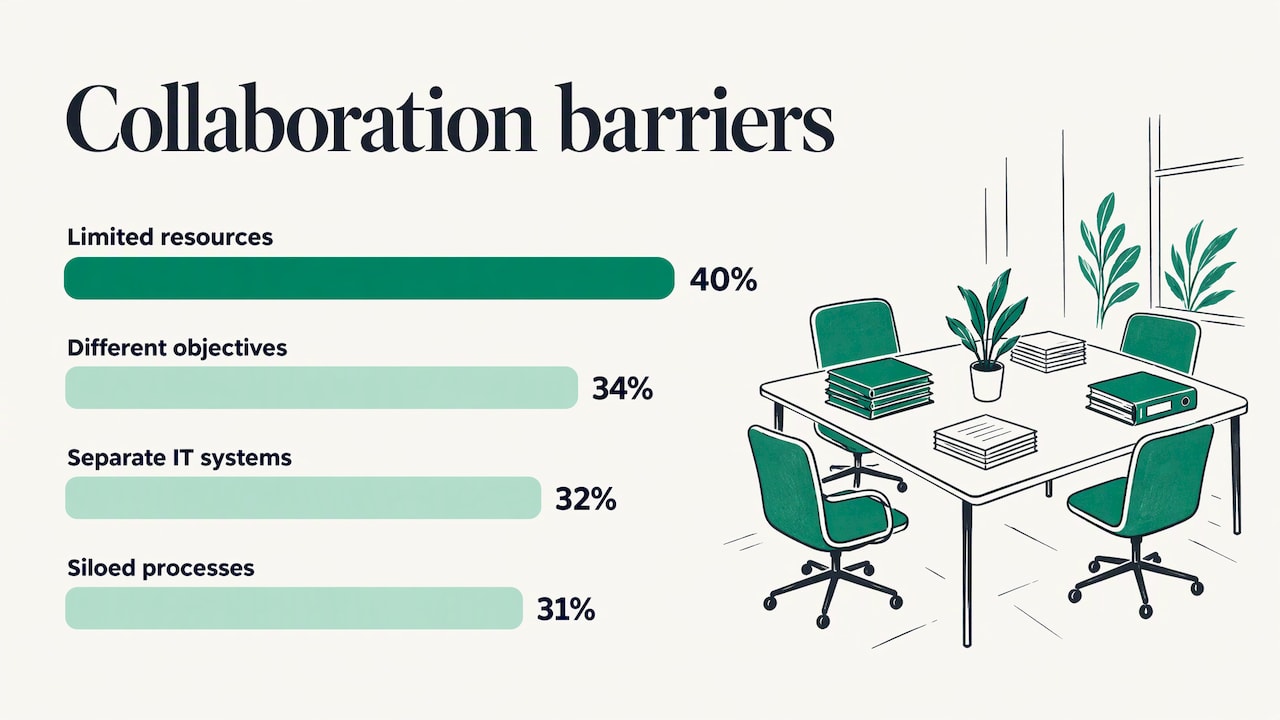
Duplication is the real cost of getting this wrong. The Internal Audit Foundation’s 2026 report found that limited resources or competing priorities were the most cited barrier to collaboration between internal audit and ERM functions (40%), followed by differences in objectives (34%), separate IT systems (32%) and siloed processes (31%). Three of those four are about structure and tooling rather than people.
Risk Publishing recommends four integration patterns that work in any sector:
- One risk taxonomy with two views. ERM reports roll up at the top level of the taxonomy, while GRC obligations tag to the level below.
- Risk appetite as the link. The board sets appetite through ERM, and GRC translates it into control objectives.
- Clear lines. ERM and compliance are both second line functions, so they need a regular conversation, ideally weekly.
- Aligned board reporting. One integrated risk pack each quarter in place of two separate stories.
The cost of skipping a shared taxonomy is credibility. The same source warns that without one, the board may see top cyber risks in the ERM pack that do not reconcile to the top cyber findings in the audit report. You can read the full reasoning in Risk Publishing’s comparison.
What this means for EU organisations
For companies and public bodies in the European Union, the question is rarely theoretical. Several legal texts and standards require a documented, board-visible approach to risk and proof that it is operating.
NIS2
Directive (EU) 2022/2555, known as NIS2, requires essential and important entities to take appropriate and proportionate cybersecurity risk-management measures and gives their management bodies responsibility for approving and overseeing those measures. That is an ERM style obligation (identify, assess, treat, report to leadership) and a GRC style obligation (policies, controls and evidence) at once. Scope depends on sector and size, so check the directive and your national transposition to confirm whether you are covered.
DORA
Regulation (EU) 2022/2554, the Digital Operational Resilience Act, requires financial entities to maintain an ICT risk management framework and places responsibility for it with the management body. It also covers incident reporting, resilience testing and the management of ICT third party risk. Supplier concentration, the same risk that ERM raises to the board, appears here as a regulatory topic.
ISO 27001
ISO/IEC 27001 asks an organisation to define how it assesses and treats information security risks, to set controls, to review them and to keep documented information showing the system operates. Certification is a customer facing way to prove it. The standard is a management system, so it behaves like GRC in miniature: governance, risk and compliance in one cycle.
GDPR
Regulation (EU) 2016/679 expects controllers and processors to implement security measures appropriate to the risk. A data protection impact assessment is a risk method as well, so GDPR work draws on the same risk language as the rest.
Put together, the legal picture explains why most EU companies need both lenses. ERM gives the board a view of how much risk is tolerable. GRC turns that into policies, controls and records that satisfy a regulator, an auditor or a customer. You can see how these frameworks relate on the standards overview and read practical walk-throughs on the Guardiso blog.
Which one should you start with?
The right starting point depends on what is driving the work.
| Your situation | Sensible starting point |
|---|---|
| Customers or tenders ask for ISO 27001 or a security questionnaire | GRC: build the management system, control library and evidence first |
| You are in scope of NIS2 or DORA | GRC for obligations and evidence, with ERM supplying the risk method and board reporting |
| The board wants a view of strategic and operational risk across the business | ERM: appetite, taxonomy and a quarterly risk report |
| You already have an ERM function and a separate compliance team | Integration: shared taxonomy, one risk pack, one evidence store |
| You are a consultant handling several clients | GRC tooling that maps one set of evidence to many frameworks |
For a company of 10 to 250 people, a separate ERM department and a separate GRC department are rarely realistic. A small team usually owns both, so the practical aim is one risk register, one control library and one place where evidence lives.
The role of tooling
Spreadsheets work for a first risk register. They struggle once several standards, several owners and an external audit are involved. Controls get copied between files, evidence goes out of date and nobody can say what is open without asking around.
Technology can connect the two disciplines through workflow automation, a shared data model and integrations with the systems where evidence already lives. EY describes this direction as technology enabled risk management, with risk and GRC systems tied into enterprise technology so insight arrives in near real time and the cost of managing risk falls.
When you assess any GRC platform, use criteria that follow from the above:
- Can one control or document be mapped to several standards, so work is done once?
- Does it collect evidence from the systems you already use?
- Does it hold a risk register that links to controls and tasks?
- Can it show status, risks and open tasks to a board in one view?
- Where is the data stored, and under which jurisdiction?
How Guardiso supports this
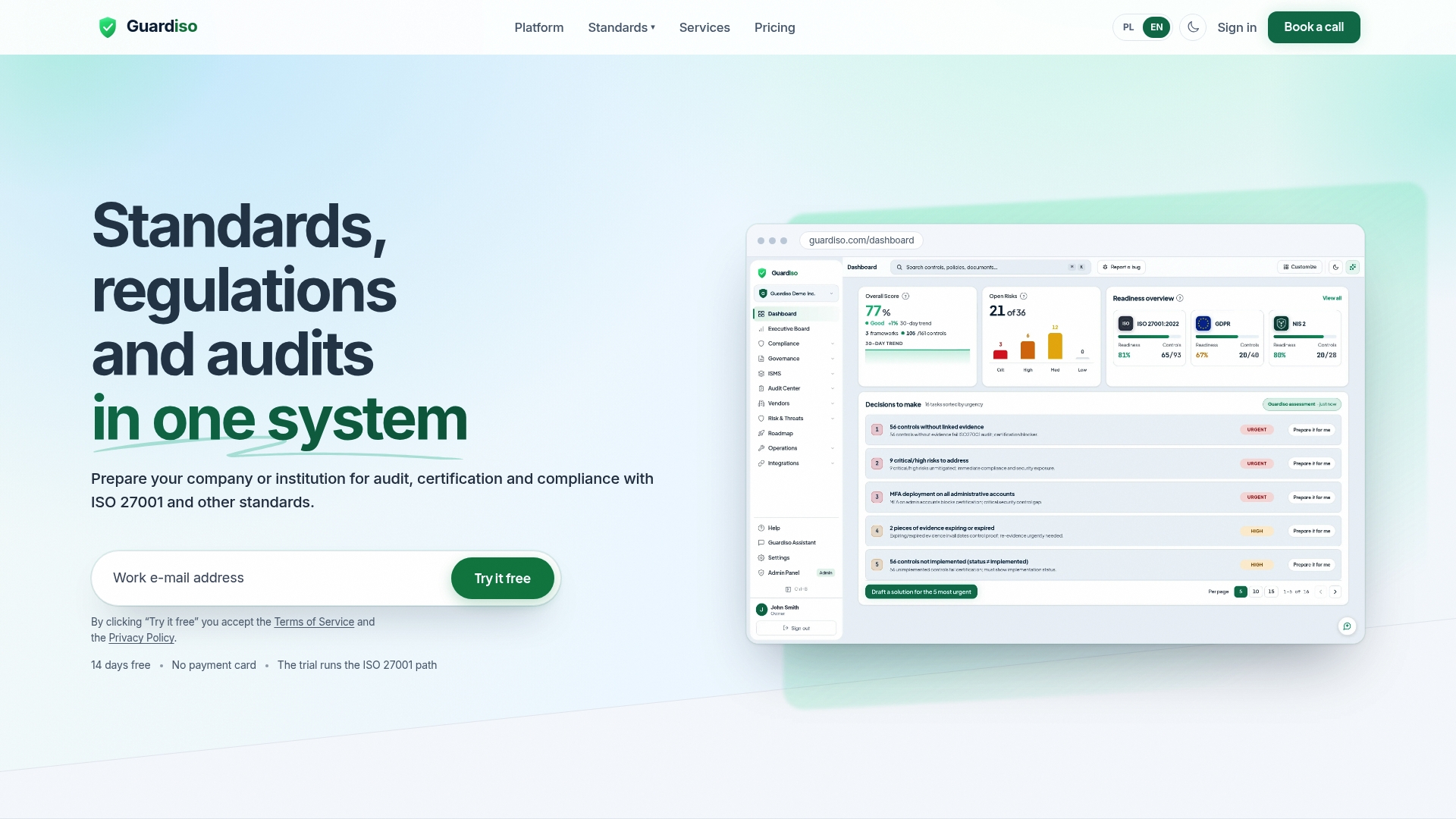
Guardiso is a platform for managing information security and regulatory compliance. In one system a company can run ISO 27001, GDPR, NIS2, DORA, SOC 2, ISO 22301 and about 30 other standards. One set of documents and evidence is designed to serve many regulations, so the team does not repeat the same work for each new framework.
The platform includes standards mapping, policy and document templates, risk and evidence registers, audit planning, compliance questionnaires and a board dashboard that shows compliance status, risks and open tasks. Evidence can be collected automatically from tools such as Microsoft 365, GitHub and AWS through integrations. Before an audit, Guardiso prepares an evidence pack for the auditor, and an auditor portal supports electronic signatures. Data is stored only in the European Union, and Firma Guardiso posiada certyfikat ISO 27001 in English: Guardiso is an ISO 27001 certified company. Details are on the security page.
Plans are published on the pricing page: Starter at €199 per month and Professional at €499 per month, with Enterprise available on request. You can see how integrations and evidence work on the platform page. If you need expert capacity next to the software, Guardiso also offers a part-time security officer service and security testing through its services pages.
Common pitfalls when aligning the two
Two vocabularies. If ERM rates a risk as high and GRC rates the same issue as medium, nobody trusts either number. Agree on one scale and one taxonomy first.
Independence. The Internal Audit Foundation lists maintaining the independence of internal audit and providing unbiased assurance over second line functions among the key challenges as the two landscapes converge. Keep the third line separate from the people who run the controls it tests.
Tool first, design later. Buying a platform before agreeing owners, scales and reporting simply moves the silos into software. Decide the model, then configure the tool to match it.
Treating compliance as the finish line. A control can satisfy an obligation and still leave strategic exposure. Keep an ERM review of residual risk even when the compliance status is green.
Letting evidence age. An evidence pack built in a rush before an audit is stressful and error prone. Continuous collection and scheduled reviews spread the work across the year.
A simple way to begin
- List your drivers. Which laws, standards and customer contracts apply? Include NIS2, DORA, GDPR and ISO 27001 where relevant.
- Define one risk taxonomy. Two levels are enough for most mid-sized firms.
- Set appetite with the board. Write down what level of risk is acceptable for the main categories.
- Build one control library. Map each control to every requirement it supports.
- Assign owners and review dates. Each control, risk and policy needs a named person.
- Report once. One quarterly pack that shows strategic risks and compliance status together.
- Collect evidence continuously. Automate what you can, and review the rest on a fixed calendar.
FAQ
Is GRC the same as ERM?
No. ERM is the discipline of managing risks that affect strategy and objectives. GRC is a wider model that also covers governance and compliance, and the term is used for software as well. ERM is best seen as the risk part of a complete GRC capability.
Do we need both GRC and ERM?
Most organisations that face regulation and customer scrutiny need both views. ERM gives leadership a picture of strategic and operational risk, and GRC turns obligations into controls and evidence. In a small company one team can cover both, as long as they share one risk register and one set of evidence.
Is GRC the same as IT audit?
No. IT audit is an independent assessment, usually a third line activity, that tests whether IT controls work. GRC is the management framework that runs those controls and keeps the records an auditor will examine. Internal audit stays independent of the teams it reviews.
What are the four pillars of ERM?
Framings differ by standard and author, but a common way to describe the cycle has four steps: identify risks, assess them, respond to them and monitor and report. Strategy and risk appetite sit above these steps and set the tolerance for the whole cycle.
How do GRC and ERM help with NIS2 or DORA?
Both laws expect a documented risk management approach that management oversees, supported by evidence. ERM supplies the method and board level reporting, and GRC supplies the policies, controls and records. Read the legal texts and your national rules to confirm scope.
Sources
- What is GRC (Governance, Risk, and Compliance)? OCEG
- Defining the Terms of Risk Management, The Hackett Group
- Guidelines for the risk function 2025, IIA Norway
- GRC vs ERM: How Governance, Risk, and Compliance Differs, Risk Publishing
- Collaboration Without Compromise, Internal Audit Foundation
- IRM+: technology-enabled risk management, EY
- Directive (EU) 2022/2555 (NIS2), EUR-Lex
- Regulation (EU) 2022/2554 (DORA), EUR-Lex