
Automated Evidence Collection for Audits: How It Works
Automated evidence collection means your systems record the proof an auditor will ask for as events happen, and a platform stores it against the right control. Integrations pull configuration states, access records and approvals on a schedule. You review the results instead of taking screenshots the week before an audit. This guide explains what can be collected automatically, how to map it to ISO 27001, NIS2 and DORA, and how to check it before the auditor does.
What automated evidence collection is
An auditor tests whether a control exists and whether it operated over a period. A control is only as convincing as the record behind it: a list of users with admin rights, a log of who approved a change, a backup report, a training register.
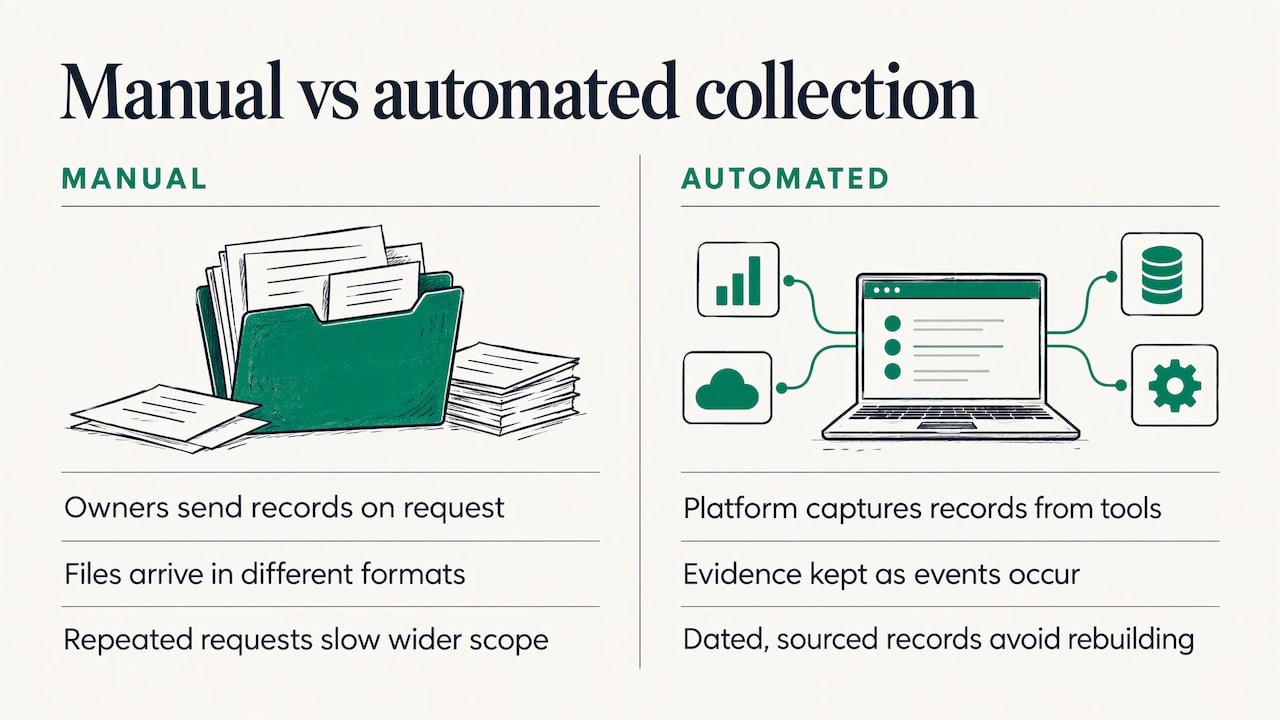
Manual collection means someone asks each owner for these records, receives them in different formats and files them in a folder. It works for one framework and a small scope. It becomes slow when the same records are requested again for another standard, a customer questionnaire or a new audit period.
In automated collection, a platform connects to your existing tools and captures the records itself. One description of continuous evidence automation frames the idea as designing systems so evidence is retained as events occur rather than assembled from screenshots and spreadsheets at audit time. The result is a dated, sourced record that was not rebuilt from memory.
What evidence can be collected automatically
Anything a system already records can usually be captured. Typical categories are:
- Identity and access: user lists, role assignments, multi-factor authentication status, joiner and leaver records.
- Configuration: cloud settings, encryption status, security group rules, device compliance state.
- Change management: pull requests, code review approvals and deployment records from a code repository.
- Logs: audit trails and user activity, ideally aggregated centrally with a defined retention period.
- Vulnerability and patch data: scan outputs and update status.
Cloud providers document this in detail. For example, the official documentation for AWS Audit Manager says it gathers automated evidence from four data source types: CloudTrail for user activity, Security Hub and Config for compliance checks, and API calls for configuration data. The same page notes that some controls do not support automated evidence collection, which is why a sound process plans for both kinds from the start.
In Guardiso, evidence is collected through integrations with tools such as Microsoft 365, GitHub and AWS. The platform stores it in the evidence register next to the risks, documents and tasks it relates to. The platform page lists the integrations and evidence types.
How the collection loop works
Most implementations follow the same loop.
- Connect. You authorise read access to a system through an integration or API.
- Pull. The platform fetches the current state on a schedule or when something changes.
- Compare. The new state is compared with the previous known-good state. One published description of continuous compliance monitoring explains that unchanged controls cost nothing to process and only real changes trigger analysis.
- Record. The platform stores the evidence with a timestamp, source and the control it supports.
- Alert. If a control moves from passing to failing, the control owner is notified and a task is raised.
The same pattern appears in engineering pipelines. One infrastructure guide describes a scheduled job that exports state and uploads evidence artefacts to a central archive, while another job compares desired and actual configuration and fails when drift is found.
The drift alert is where automation pays off between audits. A leaver whose account stays active, an expired key or a storage bucket whose settings changed are found when they happen. They do not turn up as findings months later.
Mapping evidence to ISO 27001, NIS2 and DORA
The three regimes ask different questions but share many underlying records.
- ISO 27001 is a management system standard. Your certification auditor expects documented information that shows the controls you selected are implemented and operating. ISO publishes the standard itself, and the clause on documented information covers how records are created, controlled and retained.
- NIS2 requires essential and important entities to take appropriate and proportionate technical, operational and organisational measures. The measures are listed in Article 21 of Directive (EU) 2022/2555 and include risk analysis, incident handling, business continuity, supply chain security, access control and the use of cryptography.
- DORA applies to financial entities and sets out ICT risk management, incident reporting, resilience testing and third-party risk requirements in Regulation (EU) 2022/2554.
A practical mapping looks like this:
| Evidence item | Source system | ISO 27001 | NIS2 | DORA |
|---|---|---|---|---|
| Quarterly access review | Identity provider | Access control | Access control and asset management | ICT risk management |
| Backup and restore test report | Cloud or backup tool | Backup and continuity | Business continuity and crisis management | ICT business continuity |
| Vulnerability scan output | Scanner | Technical vulnerability management | Vulnerability handling | Digital operational resilience testing |
| Supplier assessment | Questionnaire register | Supplier relationships | Supply chain security | ICT third-party risk |
| Incident record | Ticketing tool | Incident management | Incident handling and reporting | Incident management and reporting |
The table is a planning aid. Always confirm the exact clause or article with the legal text and your own control set before you rely on a mapping.
Keep one library
The common mistake is a folder per framework. A published approach to multi-framework programmes recommends instead one evidence library, with each item mapped to several frameworks and given an owner. Guardiso is built on the same idea: one set of documents and evidence serves many regulations, so the team does not repeat the same work when it adds a new standard. If you also handle SOC 2 or PCI DSS requests from customers, the same library applies to SOC 2 and PCI DSS controls.
What still needs a person
Automation covers what systems record. Other evidence comes from people and decisions, and a good process assigns it from the start.
- Approvals and decisions: management review minutes, risk acceptance, policy sign-off.
- Training and awareness: attendance or completion, if it is not exported from a learning tool.
- Physical and organisational controls: office access, supplier meetings, onboarding checks.
- Exceptions: an automated test flags the failure, and a person documents why it happened and what was done.
- Interpretation: deciding which evidence demonstrates a control in your context.
Treat these as recurring tasks with owners and due dates in the same register as the automated items. Guardiso shows open tasks together with compliance status and risks, so the human part of the evidence plan stays visible. Its auditor portal supports electronic signatures for approvals that must be signed.
Preparing and validating evidence before the audit
Collecting is half the work. The other half is making sure the auditor can use what you hand over.
Check each item
For every item, confirm that it:
- maps to a specific requirement or control
- sits within the audit scope and the audit period
- is the latest approved version
- shows who did what, when and where
A published audit evidence checklist adds quality checks: confirm completeness, remove duplicates and conflicting versions, test attachments, document exceptions and corrective actions, and carry out a second-person review. Teams that want to systematise this kind of review can look at ideas for digitising audit quality checks in other regulated sectors.
Think like the auditor
Auditors judge whether evidence is genuine, relevant and reliable. One professional guide lists four techniques in increasing order of strength: inquiry, observation, inspection and re-performance. Automated records support inspection and re-performance well because they carry timestamps and a source system. The same guide advises sampling, tracing records from start to finish and verifying dates against source systems before the auditor does.
Build a reviewable package
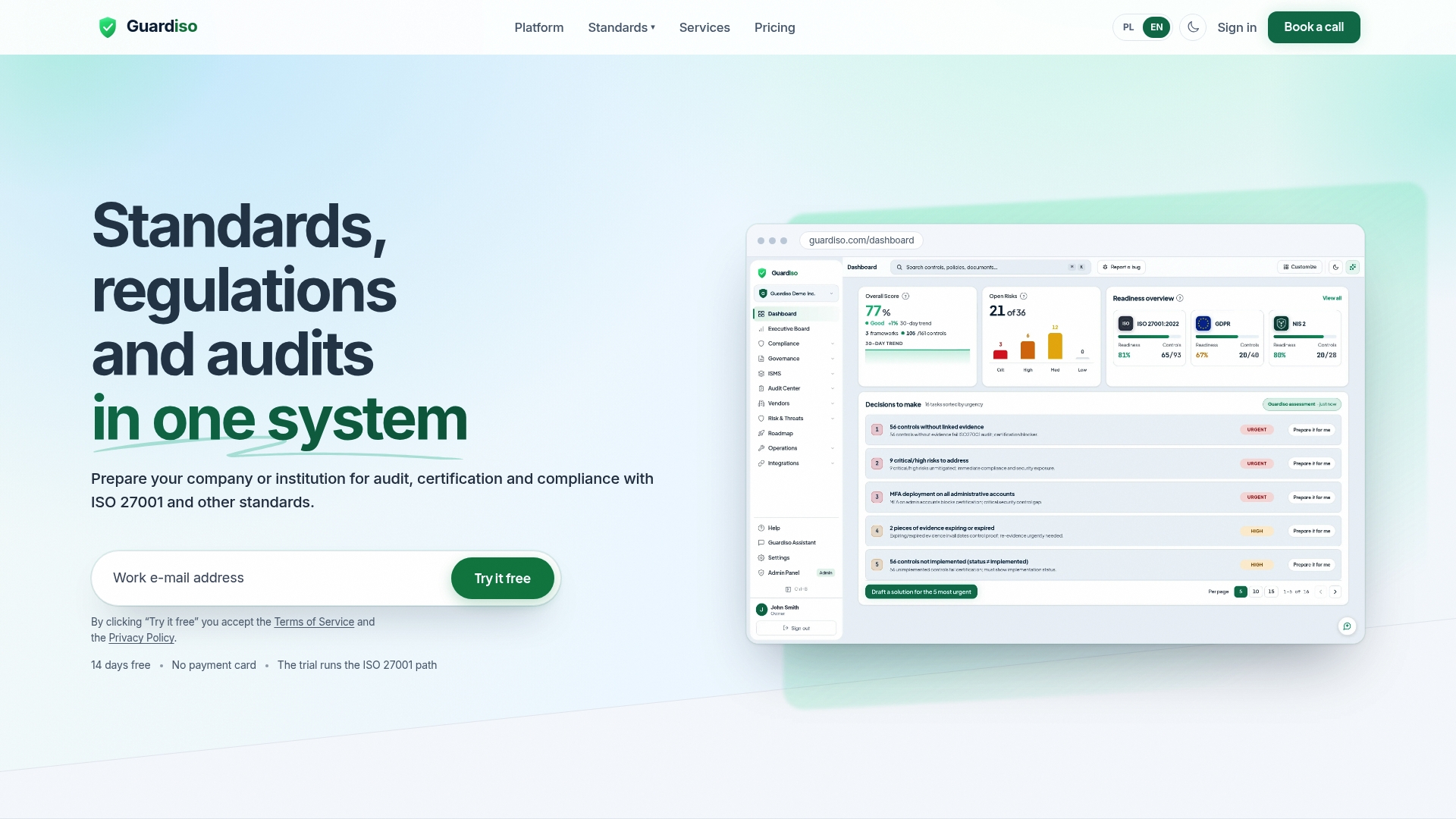
A folder of files is hard to challenge or trust. A reviewable package includes for each item the control area, an accountable owner and a backup, the source reference, the collection date and period, and any exception notes. A published description of governed evidence packages also recommends recording missing or partial status and the reviewer’s final decision. Guardiso prepares the evidence pack for the auditor from the registers it already holds, and the auditor portal gives the auditor one place to work.
A rollout plan for a small team
For a company with 10 to 250 employees, a staged start works better than connecting everything at once.
- List the frameworks and customer requests you answer. Include ISO 27001, NIS2, DORA, GDPR and any customer questionnaires.
- Select the controls shared by most of them. Access, change, backup, vulnerability and supplier controls usually come first.
- Connect the three or four systems that hold the most evidence. For many teams these are the identity provider, the code repository and the cloud platform.
- Assign an owner and a backup to every evidence item. Automated or manual makes no difference here.
- Schedule a monthly review. Look at failing controls, missing items and exceptions, and close tasks before the audit window.
- Run a mock pack review. Ask a colleague who did not collect the evidence to trace five items from control to source.
Evidence also supports your customer-facing assurance. Guardiso’s Trust Center and security portal let you share compliance status with partners, and our security page explains how we protect the data you store with us. Data is stored only in the European Union, which matters for organisations working under GDPR, NIS2 or DORA.
How Guardiso supports evidence collection
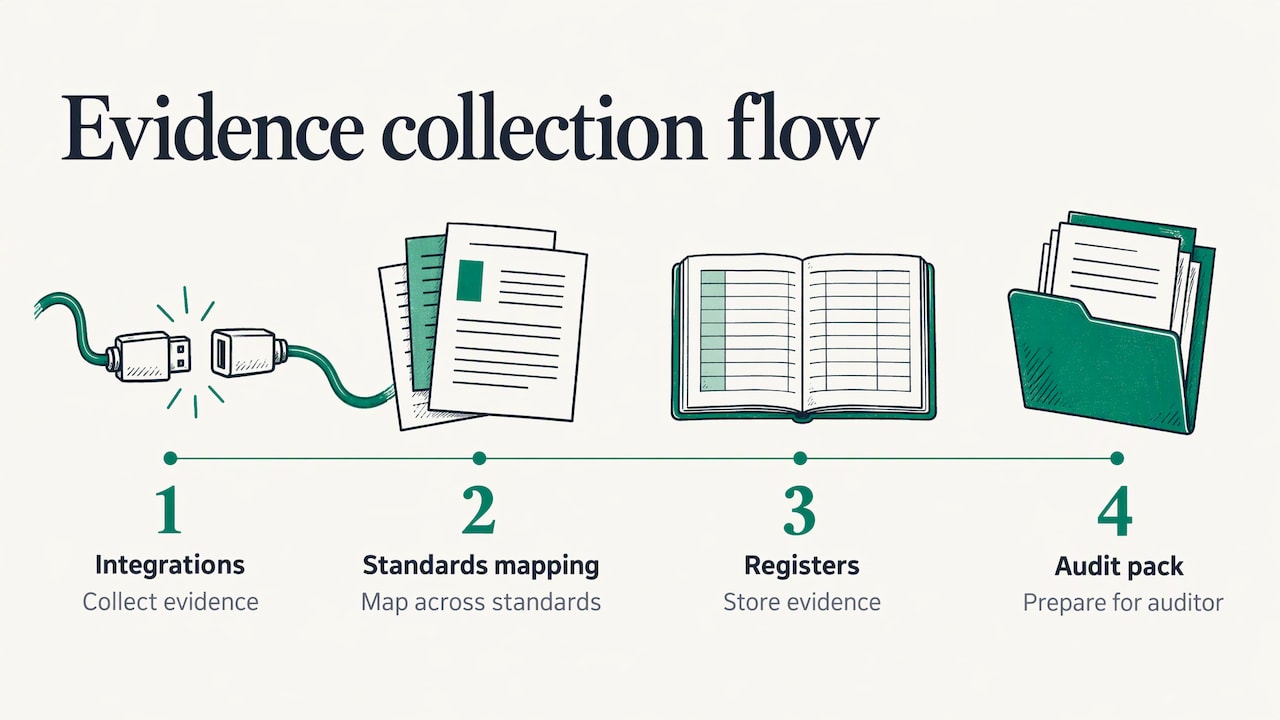
Guardiso is a platform for managing information security and compliance in one system. It covers ISO 27001, GDPR, NIS2, DORA, SOC 2, ISO 22301 and about 30 other standards. Evidence is collected through integrations, mapped across standards and stored in registers. Before an audit, the platform prepares a complete evidence pack for the auditor. Ready policies are available in English and Polish. Guardiso is an ISO 27001 certified company.
Plans start at €199 per month for Starter and €499 per month for Professional. Enterprise pricing is available on request. See the pricing page for what each plan includes, or visit the Guardiso home page to start a trial or request a demo.
If you need an independent view of your controls before an audit, our security audits, penetration tests and vCISO services produce findings that can be stored as evidence in the same platform.
FAQ
What is automated evidence collection?
It is the scheduled or event-driven capture of the records an auditor tests, such as configurations, access lists, logs and approvals, through integrations and APIs. The records are stored with a timestamp and source and linked to the control they support. Your team reviews them instead of gathering them by hand.
Can automated evidence be reused across ISO 27001, NIS2 and DORA?
Yes, where the same underlying control is requested. An access review or backup test report can support requirements in several frameworks if each item is mapped to every requirement it satisfies. Confirm the exact mapping against the standard and the legal text, and keep one owner per item.
Does automation replace the auditor or the human review?
No. The auditor still decides whether the evidence is sufficient, and your team still owns approvals, exceptions and interpretation. Automation removes repetitive gathering so people can spend time on those decisions.
How often should evidence be collected?
Match the frequency to how fast the control changes. Configuration and access data suit daily or on-change collection, while management reviews and supplier assessments follow their own cycle. Your auditor or certification body can confirm what period of operation they expect for each control.
Sources
- Directive (EU) 2022/2555 (NIS2), EUR-Lex
- Regulation (EU) 2022/2554 (DORA), EUR-Lex
- Examples of AWS Audit Manager controls, AWS Documentation
- Audit Evidence Automation, VerSprite
- What Is Continuous Compliance Monitoring, Xorabyte
- How to Automate Compliance Audits with OpenTofu, OneUptime
- Reuse SOC 2 and ISO 27001 evidence, Canadian Cyber
- Audit Evidence Checklist, Ocasta
- Control Evidence Explained, CertPro
- A governed, reviewable evidence package, KeepSolid
- Care audits and how to digitise them, Weave